CGPA to Percentage Calculator
Convert CGPA or SGPA into percentage using your university's official formula, 45+ universities, or convert a percentage back into CGPA.
Enter each semester's SGPA and its total credits. The calculator uses a credit-weighted average, which is the correct method: a plain average is only right when every semester carries the same credits. Leave credits blank to weight all semesters equally.
Enter your marks out of 100 for the five main subjects. Grade points follow the CBSE 9-point scale. This applies to Class 10 and older CBSE patterns. CBSE discontinued CGPA reporting for Class 12.
Recent conversions
How to convert CGPA to percentage
To convert CGPA to percentage, multiply your CGPA by the multiplier your university publishes. The most widely used CGPA to percentage conversion is the CBSE standard:
Percentage = CGPA × 9.5
So an 8.2 CGPA becomes 8.2 × 9.5 = 77.9%. That is the answer to how to calculate CGPA to percentage in the general case. Many universities publish their own formula though, and that is where students go wrong. Search for your institution in the CGPA to percentage calculator above, it covers more than 45 Indian universities and boards, and the correct multiplier is applied automatically.
The steps for how to convert CGPA into percentage are: read the CGPA from your marksheet, search your university, and read the result. The tool shows the exact formula it used, so you can check the arithmetic yourself rather than trusting a black box.
CGPA to percentage formula for different universities
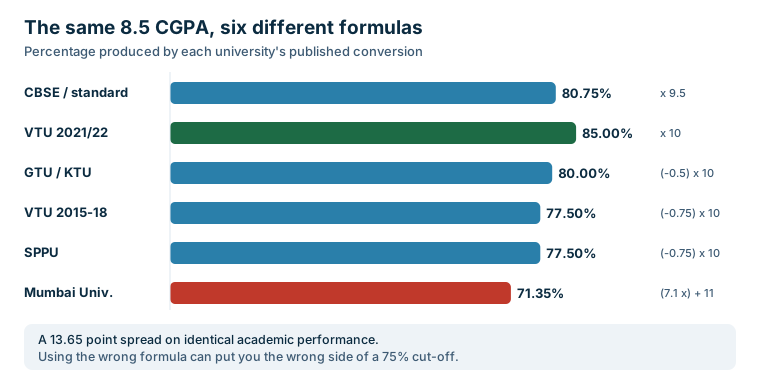
There is no single national formula, and this matters before you calculate CGPA to percentage for anything official. The same 8.5 CGPA converts to 80.75% under CBSE, 77.5% under the older VTU scheme, and 71.35% under Mumbai University's formula: a spread of more than nine points on identical performance.
| University / board | Formula | 8.0 CGPA becomes |
|---|---|---|
| CBSE / general standard | CGPA × 9.5 | 76.00% |
| VTU (2015 / 2017 / 2018 scheme) | (CGPA − 0.75) × 10 | 72.50% |
| VTU (2021 / 2022 CBCS) | CGPA × 10 | 80.00% |
| SPPU / Pune University | (CGPA − 0.75) × 10 | 72.50% |
| Mumbai University (general) | (7.1 × CGPA) + 11 | 67.80% |
| Mumbai University (engineering) | (7.4 × CGPA) + 12 | 71.20% |
| Anna University | CGPA × 10 | 80.00% |
| GTU | (CGPA − 0.5) × 10 | 75.00% |
| MAKAUT | CGPA × 10 | 80.00% |
| AKTU / UPTU | CGPA × 9.5 | 76.00% |
| KTU | (CGPA − 0.5) × 10 | 75.00% |
A VTU CGPA to percentage calculator needs a scheme selector and not one formula, because VTU changed its rule: the 2015, 2017 and 2018 schemes subtract 0.75 before multiplying, while the 2021 and 2022 CBCS regulations multiply directly by 10. Picking the wrong scheme shifts your result by 7.5 percentage points.
For a SPPU CGPA to percentage conversion the widely cited rule is (CGPA − 0.75) × 10. A GTU CGPA to percentage conversion generally subtracts 0.5 instead. A MAKAUT CGPA to percentage conversion is the least settled of the major universities, published sources quote three different formulas. An Anna University CGPA to percentage calculator normally uses a direct × 10.
The CGPA to percentage Mumbai University case surprises people most. Under (7.1 × CGPA) + 11, a perfect 10 CGPA converts to 82%, not 100%. Mumbai University is also reported to have repealed formula-based conversion from January 2026 in favour of a marks-based conversion certificate, if you are a Mumbai student, check with your examination cell before quoting any formula-derived number.
Every formula in the tool carries a badge. A green badge means published sources agree; an amber badge means sources disagree and you should confirm with your own university before using the figure officially. That distinction is deliberately visible rather than hidden, because a wrong percentage on a job or admission form is a real problem.
Percentage to CGPA calculator
The reverse conversion is the formula inverted. The percentage to CGPA formula under the CBSE standard is:
CGPA = Percentage ÷ 9.5
So to convert percentage to CGPA, 75% ÷ 9.5 = 7.89 CGPA. If you want 70 percentage to CGPA, that is 70 ÷ 9.5 = 7.37 CGPA. For SPPU or the older VTU scheme, the percentage to CGPA out of 10 conversion is (Percentage ÷ 10) + 0.75 instead.
Use the second tab as a percentage to CGPA converter: the same page also works as a CGPA to percentage converter in the other direction. A CBSE percentage to CGPA conversion uses ÷ 9.5; a VTU percentage to CGPA conversion uses the VTU scheme formula reversed.
CGPA into percentage, quick conversion table
If you just want to look up a common value, this table shows the four most-used formulas side by side. It answers the specific searches people make most, 8 CGPA into percentage, 8.8 CGPA into percentage, 7 CGPA into percentage, 9.2 CGPA into percentage, 7.4 CGPA into percentage, 8.4 CGPA into percentage and 8.2 CGPA into percentage.
| CGPA | CBSE (×9.5) | VTU/SPPU (−0.75)×10 | GTU/KTU (−0.5)×10 | Mumbai (7.1×)+11 |
|---|---|---|---|---|
| 10 | 95.00% | 92.50% | 95.00% | 82.00% |
| 9.8 | 93.10% | 90.50% | 93.00% | 80.58% |
| 9.5 | 90.25% | 87.50% | 90.00% | 78.45% |
| 9.2 | 87.40% | 84.50% | 87.00% | 76.32% |
| 9.0 | 85.50% | 82.50% | 85.00% | 74.90% |
| 8.8 | 83.60% | 80.50% | 83.00% | 73.48% |
| 8.5 | 80.75% | 77.50% | 80.00% | 71.35% |
| 8.4 | 79.80% | 76.50% | 79.00% | 70.64% |
| 8.33 | 79.14% | 75.80% | 78.30% | 70.14% |
| 8.2 | 77.90% | 74.50% | 77.00% | 69.22% |
| 8.0 | 76.00% | 72.50% | 75.00% | 67.80% |
| 7.8 | 74.10% | 70.50% | 73.00% | 66.38% |
| 7.6 | 72.20% | 68.50% | 71.00% | 64.96% |
| 7.4 | 70.30% | 66.50% | 69.00% | 63.54% |
| 7.2 | 68.40% | 64.50% | 67.00% | 62.12% |
| 7.0 | 66.50% | 62.50% | 65.00% | 60.70% |
| 6.5 | 61.75% | 57.50% | 60.00% | 57.15% |
| 6.0 | 57.00% | 52.50% | 55.00% | 53.60% |
| 5.5 | 52.25% | 47.50% | 50.00% | 50.05% |
| 5.0 | 47.50% | 42.50% | 45.00% | 46.50% |
Read across the row for your CGPA and down to the column for your university. If your university is not one of these four, use the CGPA into percentage calculator at the top, which covers 45+ institutions and accepts a custom multiplier.
SGPA to percentage
SGPA and CGPA convert to percentage with exactly the same formula. The difference is what they measure: SGPA is one semester's grade point average, while CGPA is cumulative. Enter your SGPA in the CGPA field above and pick your university.
If you need to work out the SGPA itself from your subject grades and credits, or combine several semesters into a CGPA, use the dedicated SGPA calculator, which handles UGC CBCS, VTU and KTU grade scales.
One practical warning for applications: submit your CGPA, not a single semester's SGPA. A strong final-semester SGPA is often higher than the cumulative CGPA, and recruiters can verify the difference against your official transcript.
CBSE CGPA calculator, marks to CGPA
The CBSE Marks tab works in the other direction: it turns subject marks into a CGPA. CBSE assigns each subject a grade point on a 9-point scale (91–100 is 10 points, 81–90 is 9, and so on in bands of ten), then averages the grade points of the five main subjects.
This is what a 10th CBSE CGPA calculator or class 10 CBSE CGPA calculator does. CBSE discontinued CGPA reporting for Class 12, so if you are looking for a 12th CBSE CGPA calculator, your Class 12 marksheet reports percentages directly, use the marks percentage calculator instead.
CGPA to percentage out of 4: the US GPA scale
Students applying abroad often need CGPA to percentage out of 4, which really means converting a 10-point CGPA to a 4.0-scale GPA. The common approximation is:
GPA (4.0) = (CGPA ÷ 10) × 4
So an 8.0 CGPA is roughly 3.2 on a 4.0 scale. Treat this as an estimate. Credential evaluation services such as WES convert grade by grade using institutional profiles, so the figure on your official evaluation can differ. Use the estimate to gauge whether you meet a stated cut-off, then rely on the official evaluation for the application itself.
Sharing and rechecking your result
Every conversion can be shared as a link. The Share button copies a URL that already contains your CGPA and your selected university, so whoever opens it sees the same calculation filled in, useful when confirming a figure with a placement coordinator or a friend at the same college.
The calculator also keeps your recent conversions listed below the tool, so you can compare several CGPAs, or the same CGPA under different university formulas, without retyping. Nothing is uploaded: the history stays on your own device and the Clear history button removes it.
Why the right formula matters
- Eligibility cut-offs, many recruiters and PSUs set a hard 60% or 70% bar. Under Mumbai's formula a 7.0 CGPA is 60.7%, just clearing 60%; a generic × 9.5 would show 66.5% and mislead you about your margin.
- Division and class. First Class, First Class with Distinction and Second Class thresholds are defined in percentage terms, so the formula decides which division you fall into.
- Foreign applications, some overseas universities want a raw percentage, and a mismatch against your transcript raises questions.
- Government exam forms, these often ask for percentage with no CGPA field, and an inflated figure on a government form is a serious problem.
When quoting a converted figure, name the formula alongside it, for example "CGPA 8.2 / 10, equivalent to 69.22% per the Mumbai University CBCS formula". That reads as precision instead of an inflated claim, and lets an evaluator check your working.
Frequently asked questions
How to convert CGPA to percentage?
Multiply your CGPA by your university's official multiplier. The most widely used formula is Percentage = CGPA × 9.5, which is the CBSE standard. For example, 8.2 CGPA × 9.5 = 77.9%. Many universities use their own formula instead, so search for yours in the calculator above.
What is the formula for CGPA to percentage conversion?
The general formula is Percentage = CGPA × 9.5. University-specific formulas include (CGPA − 0.75) × 10 for VTU's older schemes and SPPU, (CGPA − 0.5) × 10 for GTU and KTU, CGPA × 10 for Anna University, and (7.1 × CGPA) + 11 for Mumbai University.
Does every university use the same CGPA formula?
No, and this is the single biggest source of error. An 8.5 CGPA is 80.75% under the CBSE × 9.5 formula, 77.5% under the VTU 2018 scheme, and 71.35% under the Mumbai University formula. Using the wrong formula can change your percentage by more than ten points.
How to convert percentage to CGPA?
Reverse the formula. Under the CBSE standard, CGPA = Percentage ÷ 9.5, so 75% ÷ 9.5 = 7.89 CGPA. For SPPU or the older VTU scheme, CGPA = (Percentage ÷ 10) + 0.75. Use the Percentage to CGPA tab and select your university.
How to convert SGPA to percentage?
SGPA converts using the same formula as CGPA: the only difference is that SGPA covers one semester while CGPA covers your whole programme. Enter your SGPA in the CGPA field and select your university.
How do I calculate CGPA from SGPA of all semesters?
Use a credit-weighted average: multiply each semester's SGPA by that semester's credits, add the products, then divide by the total credits. A plain average of your SGPAs is only correct when every semester carries identical credits. The SGPA to CGPA tab does this for you.
What is CGPA out of 4 (US GPA scale)?
For study-abroad applications, a 10-point CGPA is often converted using GPA = (CGPA ÷ 10) × 4, so 8.0 CGPA is roughly 3.2 on a 4.0 scale. This is only an approximation, evaluators such as WES use their own grade-by-grade methodology.
How to convert 10th CBSE CGPA into percentage?
CBSE Class 10 uses Percentage = CGPA × 9.5, so a 9.4 CGPA is 89.3%. You can also work out the CGPA from your subject marks using the CBSE Marks to CGPA tab, which converts each subject's marks into a grade point on the CBSE 9-point scale.
Why is 10 CGPA not 100 percent at some universities?
Because the multiplier is not always 10. Under Mumbai University's formula a perfect 10 CGPA converts to 82%, and under the older VTU scheme it converts to 92.5%. The multiplier reflects how each university calibrates its grade boundaries against raw marks.
Is 8 CGPA good?
An 8 CGPA is generally considered a strong first-class result. It converts to 76% under the CBSE formula, 72.5% under the older VTU scheme, and 67.8% under the Mumbai University formula. Whether it clears a specific eligibility bar depends on which formula your university uses.
Can I share my conversion result with someone?
Yes. Use the Share link button and the calculator copies a URL containing your CGPA and selected university. Anyone opening that link sees the same conversion already filled in, which is useful when checking a figure with a friend or a placement coordinator.
Can I use this converted percentage on an official form?
Treat it as an estimate. For transcripts, degree certificates and any official application, use the percentage your university itself issues or the conversion certificate it provides. Published sources disagree for several universities, so always confirm against your own institution's circular.
Where these formulas come from
- The CBSE × 9.5 conversion is the board's own published standard. See cbse.gov.in.
- The VTU scheme formulas, (CGPA − 0.75) × 10 for 2015/2017/2018 and CGPA × 10 for 2021/2022, come from VTU's CGPA standard formula notification. Check your scheme year on your grade card at vtu.ac.in.
- The SPPU rule is widely attributed to Circular 332/2020. Confirm through unipune.ac.in, since some sources quote a different multiplier.
- Mumbai University's (7.1 × CGPA) + 11 comes from its CBCS guidelines, and reports indicate the formula-based route was withdrawn from January 2026. Verify with your examination cell via mu.ac.in.
- Anna University, GTU and MAKAUT formulas are the most commonly published versions, but sources conflict. Their official sites are annauniv.edu, gtu.ac.in and makautwb.ac.in.
- The general × 9.5 multiplier is also the one recommended in AICTE guidance. See aicte-india.org.
- Anything marked with an amber badge in the tool means published sources disagree. If you have your university's official circular, send it to us and we will correct the formula and mark it verified.
Related calculators
- Marks Percentage Calculator, convert raw marks into a percentage for any board or exam.
- Attendance Calculator, check your attendance percentage and how many classes you still need.
- JEE & NEET Score Calculator, calculate your exam score with negative marking.
- Age Calculator, find your exact age from your date of birth.