SGPA Calculator
Work out your semester GPA from grades and credits, then convert SGPA to CGPA or to a percentage.
Enter each semester's SGPA and its total credits. Credits are what make this a weighted average, which is the correct method. Leave credits blank to weight every semester equally.
How to calculate SGPA
The SGPA formula is a credit-weighted average, not a plain average:
SGPA = Σ(grade point × credits) ÷ Σ credits
To calculate SGPA by hand, take each subject in the semester, multiply its grade point by its credits to get quality points, add all the quality points, then divide by the total credits. That is the whole method, and it is the answer to how to calculate SGPA at any Indian university.
Worked example
| Subject | Grade | Grade point | Credits | Quality points |
|---|---|---|---|---|
| Mathematics | A+ | 9 | 4 | 36 |
| Physics | A | 8 | 4 | 32 |
| Programming | O | 10 | 3 | 30 |
| Electronics | B+ | 7 | 3 | 21 |
| Lab | A+ | 9 | 2 | 18 |
| Total | 16 | 137 |
SGPA = 137 ÷ 16 = 8.56.
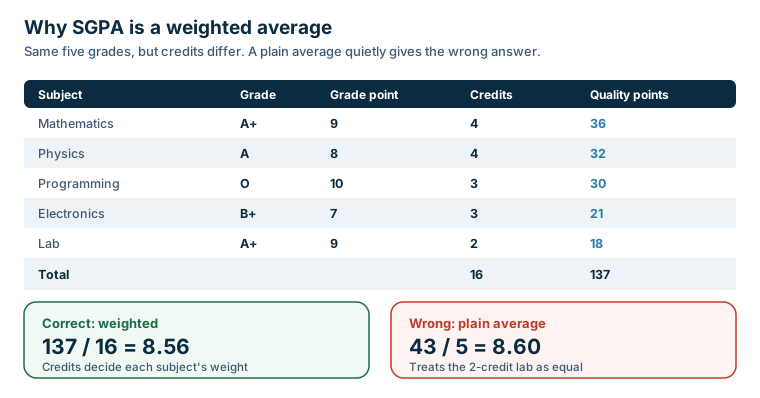
Notice what a plain average would have given: (9 + 8 + 10 + 7 + 9) ÷ 5 = 8.60. Close, but wrong, and the gap widens as your credit loads become uneven. This is the single most common mistake when people work out SGPA themselves, and it is why the SGPA calculator online above asks for credits on every row.
What is SGPA?
SGPA is the Semester Grade Point Average: your credit-weighted grade point average for one semester. The SGPA full form is exactly that, and it appears on your grade card at the end of every semester.
It exists because raw marks are hard to compare across subjects and across universities. A 72 in a demanding four-credit paper and a 72 in a light two-credit paper are not equivalent contributions to your degree, and grade points with credit weighting capture that difference.
SGPA vs CGPA: what is the difference?
People often ask what is SGPA and CGPA and treat them as interchangeable. They are not.
| SGPA | CGPA | |
|---|---|---|
| Full form | Semester Grade Point Average | Cumulative Grade Point Average |
| Covers | One semester only | Every semester completed so far |
| Changes | Fresh figure each semester | Moves gradually as semesters accumulate |
| Formula | Σ(GP × credits) ÷ Σ credits | Σ(SGPA × sem credits) ÷ Σ credits |
| Use on applications | Rarely asked for on its own | This is the figure recruiters want |
The practical consequence: one strong semester lifts your SGPA immediately but moves your CGPA only slightly, because the earlier semesters still carry their credits. Equally, one bad semester is not fatal.
How to calculate CGPA from SGPA
To work out CGPA from SGPA, weight each semester by its credits:
CGPA = Σ(SGPA × semester credits) ÷ Σ credits
Say semester 1 gave 8.0 across 20 credits and semester 2 gave 9.0 across 30 credits. The weighted result is (8.0 × 20 + 9.0 × 30) ÷ 50 = 8.60. A plain average would say 8.50, which understates you by a tenth of a point because it ignores that the stronger semester was also the heavier one.
The SGPA to CGPA calculator tab does this for as many semesters as you need. If your grade cards do not print semester credits, leave the credits blank and the tool falls back to an equal-weight average, clearly labelled so you know which method produced the number.
SGPA to percentage conversion
There is no single national rule for SGPA to percentage conversion. Each university publishes its own multiplier, and the same SGPA can differ by several points depending on which one applies to you. The most widely used SGPA to percentage formula is:
Percentage = SGPA × 9.5
| University | Formula | 8.5 SGPA becomes |
|---|---|---|
| CBSE / general standard | SGPA × 9.5 | 80.75% |
| VTU (2015 / 2017 / 2018) | (SGPA − 0.75) × 10 | 77.50% |
| VTU (2021 / 2022 CBCS) | SGPA × 10 | 85.00% |
| SPPU | (SGPA − 0.75) × 10 | 77.50% |
| GTU / KTU | (SGPA − 0.5) × 10 | 80.00% |
| Anna University | SGPA × 10 | 85.00% |
| Mumbai University | (7.1 × SGPA) + 11 | 71.35% |
That is a 13.65 point spread on identical academic performance, which is why the tool asks which university you are at rather than assuming. Use the third tab as an SGPA to percentage calculator to convert SGPA to percentage, and the fourth as a percentage to SGPA calculator when you need to work backwards from a percentage an employer or a form has asked for. The same page doubles as an SGPA to CGPA converter, since "converter" and "calculator" are the two wordings students search for and both land on the same maths.
Grade point scales: UGC CBCS, VTU and KTU
The formula never changes. The mapping from letter grade to grade point does. Under the UGC Choice Based Credit System introduced in 2015, which most Indian universities follow, the scale runs:
| Grade | O | A+ | A | B+ | B | C | P | F |
|---|---|---|---|---|---|---|---|---|
| Grade point | 10 | 9 | 8 | 7 | 6 | 5 | 4 | 0 |
A VTU SGPA calculator needs a different scale, because VTU uses S rather than O for its top grade and runs S, A, B, C, D, E, F. A KTU SGPA calculator is different again: KTU uses half-point steps such as A = 8.5 and B = 7.5, which no other major university does.
Select your scale in the first tab, or choose the last option and type grade points straight from your marksheet if your university's letters are not listed. Scales marked with an amber badge are ones where published sources disagree, so confirm those against your own grade card before relying on the result.
How to calculate SGPA from marks
Marks do not convert into SGPA directly, which surprises people searching for marks to SGPA. Your university first maps each subject's marks onto a letter grade using bands it publishes, then that letter carries a fixed grade point. Only then does the SGPA formula apply.
The bands vary. Under a common UGC CBCS mapping, 90 and above is O, 80 to 89 is A+, 70 to 79 is A, and so on in bands of ten, with the pass mark typically at 40%. Engineering programmes at VTU and Anna University often set the pass threshold higher. Check the band table printed in your own regulations, because entering a grade one step too high changes your SGPA noticeably.
Does a backlog affect your SGPA?
Yes, and more than most students expect. A failed subject scores zero grade points, but its credits still sit in the denominator. So an F both removes the quality points you would have earned and dilutes everything else you did earn.
Take the worked example above: 137 quality points over 16 credits gives 8.56. If the four-credit Physics paper had been an F instead of an A, you would have 105 over the same 16 credits, or 6.56. One subject, two full points.
Most universities recalculate once you clear the backlog, replacing the zero with your new grade, though the attempt is often still recorded on the transcript. Rules differ, so ask your examination cell rather than assuming.
Frequently asked questions
What is SGPA?
SGPA stands for Semester Grade Point Average. It is the credit-weighted average of the grade points you earned in a single semester. It covers only that semester's subjects, which is what separates it from CGPA, the cumulative average across your whole programme.
What is the SGPA full form?
The SGPA full form is Semester Grade Point Average. CGPA, by contrast, stands for Cumulative Grade Point Average.
What is the SGPA formula?
SGPA = Σ(grade point × credits) ÷ Σ credits. Multiply each subject's grade point by its credits, add those products together, then divide by the total credits for the semester. A plain average of grade points is only correct when every subject carries the same credits.
How to calculate SGPA step by step?
First, write down the grade point and credits for every subject in the semester. Second, multiply each grade point by its credits to get that subject's quality points. Third, add all the quality points together. Fourth, add all the credits together. Finally, divide total quality points by total credits. The calculator above does all five steps and shows the working.
What is the difference between SGPA and CGPA?
SGPA covers one semester; CGPA covers every semester completed so far. CGPA is calculated from your SGPAs using the same credit-weighted method: CGPA = Σ(SGPA × semester credits) ÷ Σ credits. A strong final-semester SGPA does not lift your CGPA much if earlier semesters carried more credits.
How to calculate CGPA from SGPA?
Multiply each semester's SGPA by that semester's total credits, add the products, then divide by total credits across all semesters. Use the SGPA to CGPA tab above. Averaging your SGPAs directly is only correct when every semester carries identical credits.
How to convert SGPA to percentage?
Apply your university's published multiplier. The most widely used is percentage = SGPA × 9.5, which is the CBSE standard. Universities differ: VTU's 2015 to 2018 schemes use (SGPA − 0.75) × 10, GTU uses (SGPA − 0.5) × 10, and Mumbai University uses (7.1 × SGPA) + 11.
How to calculate SGPA from marks?
Marks do not convert to SGPA directly. Your university first maps each subject's marks to a letter grade and its grade point, using bands it publishes. Once you have grade points, apply the SGPA formula. Enter your marks in the calculator above and select your scale, and it will assign grade points for you.
Does a failed subject affect SGPA?
Yes. An F carries zero grade points but its credits still count in the denominator, so a failed subject pulls your SGPA down twice over. Once you clear the backlog, most universities recalculate with the new grade, though the attempt may still be noted on your transcript.
Is SGPA calculated the same at every university?
The formula is the same everywhere: credit-weighted average of grade points. What differs is the letter-to-grade-point mapping. VTU uses S as its top grade while most universities use O, and KTU uses half-point steps. Pick the scale that matches the letters printed on your own grade card.
Can I use SGPA on a job application?
Use CGPA rather than a single semester's SGPA. A high final-semester SGPA is often above your cumulative CGPA, and recruiters can verify the difference against your official transcript. Quoting the higher figure creates a mismatch that is easy to spot.
Is this SGPA calculator free to use online?
Yes. It is a completely free online SGPA calculator with no signup and no limit. Every calculation runs inside your own browser, so your grades and credits are never uploaded anywhere.
Where these grade scales come from
- The 10-point O to F scale is the UGC Choice Based Credit System standard introduced in 2015 and adopted across most Indian universities. UGC publishes its framework at ugc.gov.in.
- Some universities substitute D for P at 4 grade points. Both appear in the tool, since the letter printed on your marksheet is what decides which applies.
- VTU's S to F scale and its percentage formulas are published in its own regulations. Check the scheme year on your grade card at vtu.ac.in.
- KTU's half-point scale is the least consistently reported of the major universities. Confirm against your own grade card via ktu.edu.in.
- Percentage multipliers follow the same sources as our CGPA to percentage calculator, including CBSE, AICTE, SPPU, GTU, Anna University and Mumbai University.
- If a scale here is wrong for your university and you have the official circular, send it to us and we will correct it and mark it verified.
Related calculators
- CGPA to Percentage Calculator — convert CGPA to percentage across 46 Indian universities.
- Marks Percentage Calculator — turn raw marks into a percentage for any board.
- Attendance Calculator — check attendance and how many classes you still need.
- JEE & NEET Score Calculator — score with negative marking.
- Age Calculator — exact age from a date of birth.