Quick mode assumes the standard +4/−1 scheme for every question. If your exam's numerical and MCQ marking ever differ, use Subject-wise mode for an exact score.
0
out of 0
0% of max
,
Subject
Correct
Wrong
Unattempted
0
out of 0
0% of max
,
How JEE Main score is calculated
JEE Main uses a +4 / −1 marking scheme for all questions. Each correct answer gives you +4 marks, each wrong answer deducts −1 mark, and unattempted questions carry 0 marks. Since the 2025 rule change, numerical/integer type questions also carry the same −1 negative marking as MCQs. The total is 75 questions (25 per subject: 20 MCQ + 5 Numerical), with a maximum score of 300.
How NEET score is calculated
NEET follows a consistent +4 / −1 scheme across all four subjects (Physics, Chemistry, Botany, Zoology). Each correct answer adds +4 marks, each wrong answer deducts −1 mark, and unattempted questions give 0 marks. There are no exceptions or optional questions: all 45 questions per subject are compulsory. The total is 180 questions with a maximum score of 720.
JEE Main and NEET negative marking rules
Negative marking is designed to discourage guesswork. In both exams, you lose 1 mark for every incorrect answer. This calculator applies the correct penalties so you can see your true score. For JEE Main, numerical questions now have the same penalty as MCQs (since 2025). For NEET, the rule is uniform across all subjects.
Subject-wise score calculator
Use the Subject-wise mode to enter your marks per subject or section. For NEET, you have four fixed subjects. For JEE Main, each subject is split into MCQ and Numerical sections. The tool sums up the scores automatically and shows your total with a formula breakdown.
JEE Score Calculator, work out your JEE Main marks
This JEE score calculator converts your correct, wrong and unattempted counts into
your JEE Main raw score using the current NTA marking scheme. JEE Main has
75 questions in total, 25 each in Physics, Chemistry and Mathematics, for a maximum
of 300 marks.
Each subject has 20 multiple-choice questions and 5 numerical-value questions, and since 2025 all 25
are compulsory. The JEE score calculator formula is:
JEE Main score = (correct × 4) − (wrong × 1)
For example, 55 correct and 12 wrong gives (55 × 4) − 12 = 208 marks out of 300.
Unattempted questions score zero, they neither add nor subtract.
NEET Score Calculator, work out your NEET UG marks
The NEET score calculator works on the same arithmetic but a much bigger paper. NEET
UG has 180 questions across Physics, Chemistry, Botany and Zoology, 45 each, for a
maximum of 720 marks.
NEET score = (correct × 4) − (wrong × 1)
So 150 correct and 25 wrong gives (150 × 4) − 25 = 575 marks out of 720. Because the
paper is so long, small changes in your wrong-answer count move the total sharply: ten extra wrong
guesses cost you 10 marks directly, plus the 40 marks you would have gained had they been correct.
JEE and NEET negative marking calculator
A JEE negative marking calculator and a
NEET negative marking calculator are really the same tool, because both exams now
deduct exactly one mark for every incorrect answer.
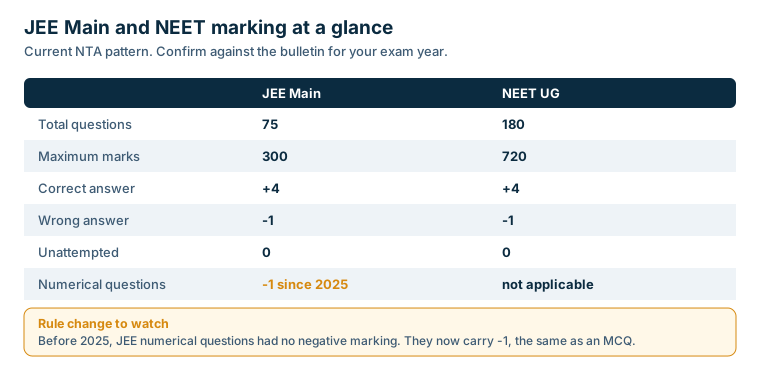
Current NTA marking for both exams, including the 2025 change to numerical questions. Confirm against the bulletin for your own exam year.
The point students most often get wrong concerns numerical questions. Before 2025, JEE Main's
numerical-value section let you attempt any 5 of 10 questions with no negative marking. That
rule was scrapped. From JEE Main 2025 onwards, all 5 numerical questions per subject are compulsory
and an incorrect numerical answer carries the same −1 penalty as an MCQ. Any older
calculator or coaching handout still showing "no negative marking for numericals" will overstate your
score.
What this means in practice is that blind guessing is now negative-expected-value in both papers. With
four options and no elimination, a random guess earns 4 marks a quarter of the time and loses 1 mark
three-quarters of the time: an average of +0.25 per guess, which sounds positive but collapses once
you account for the fact that most guesses are on questions you misread rather than truly random.
Eliminating even one option shifts the odds meaningfully in your favour; eliminating none rarely does.
JEE score calculator from response sheet
Using a JEE score calculator from response sheet is the accurate way to predict your
marks before results are declared. NTA publishes your response sheet along with the provisional answer
key a few days after the exam. The process is:
Download your response sheet and the provisional answer key from the NTA candidate portal.
Compare your recorded answer against the key for each question, subject by subject.
Count your correct answers, wrong answers and unattempted questions.
Enter those counts into the calculator above, use subject-wise mode to see where you lost marks.
A word of caution: the provisional key is not final. NTA accepts challenges, and questions are
sometimes dropped or have their key corrected. If a question is dropped, every candidate is usually
awarded the marks for it. Re-run your calculation against the
final answer key once it is published: the final key changes your correct and wrong
counts, not the formula the calculator uses.
NEET score calculator from OMR sheet
A NEET score calculator by OMR follows the same method. NTA releases scanned OMR
sheets alongside the answer key. Check your recorded responses against the key, count them, and enter
the totals here.
Two things to watch when using your NEET score calculator from OMR results. First,
verify that the OMR scan matches what you intended to mark, display errors and partially filled
bubbles are the most common grounds for a successful challenge. Second, remember that the raw score
from this NEET score calculator online is not your rank. Rank depends on how everyone
else performed, which nobody can know until results are out.
Reading your subject-wise breakdown
A total score hides where the damage happened. Two candidates can both finish on 208 in JEE Main, one
having lost marks evenly and the other having collapsed in a single subject, and their next month of
preparation should look completely different.
The subject-wise mode splits your result into Physics, Chemistry and Mathematics for JEE, or Physics,
Chemistry, Botany and Zoology for NEET. Two numbers are worth reading carefully in each subject.
The first is your accuracy: correct answers divided by attempted answers. Below roughly
70% in a subject usually means you are attempting questions you have not actually secured, and each of
those attempts costs a mark on top of the four you did not gain. The second is your
attempt rate. A very high attempt rate paired with low accuracy is the classic pattern
of guessing under time pressure, and it is the fastest thing to fix, because it needs discipline rather
than new syllabus.
The opposite pattern, high accuracy with a low attempt rate, means speed rather than knowledge is your
limit. That is a better problem to have and responds to timed practice.
Raw score, percentile and rank are three different things
People use these interchangeably and they are not the same.
Your raw score is what this page calculates: marks out of 300 for JEE Main or 720 for
NEET. It is fixed the moment the final answer key is published.
Your percentile applies to JEE Main only, and it tells you the share of candidates in
your session who scored at or below you. Because JEE Main runs across multiple shifts of differing
difficulty, NTA normalises raw scores into percentiles so that a hard shift is not penalised. This is
why the same raw score maps to different percentiles in different sessions and different years.
Your rank comes last, derived from percentile for JEE and from raw score with
tie-breaking rules for NEET. It depends entirely on the full candidate distribution, which does not
exist until every paper is marked.
This is the reason the page stops at your raw score. Any tool offering a percentile before results is
extrapolating from previous years, and previous years had different papers, different difficulty and a
different number of candidates. That estimate can be off by a wide margin at exactly the scores where
it matters most, near cut-offs, so we would rather give you one number that is correct than two where
the second is a guess.
How is JEE score calculated into percentile?
Your raw marks are not your final JEE Main result. Because JEE Main runs in multiple shifts, NTA
converts raw marks into a normalised percentile: a figure showing the percentage of
candidates who scored at or below you in your session.
This means the same raw score can produce different percentiles across different shifts and different
years, depending on paper difficulty and the number of candidates. A raw score of 200 might be a 99+
percentile in a hard session and noticeably lower in an easy one. This page calculates your raw score
accurately; it deliberately does not guess your percentile or rank, because doing so honestly requires
the actual candidate distribution, which is only known after results.
NEET does not use percentile normalisation for the score itself. NEET is a single-paper exam, so your
raw score out of 720 is your score, and rank is determined by comparing raw scores directly with
specified tie-breaking rules.
Using this calculator for coaching institute answer keys
Coaching institutes publish their own provisional answer keys within hours of each exam, usually
before NTA does. You can use those keys with this calculator to get an early estimate, but treat the
result as provisional. Coaching keys occasionally differ from the official key on ambiguous questions,
and only the NTA key determines your actual score. Once the official provisional key appears, re-count
against that instead.
Frequently asked questions
How is JEE Main score calculated?
JEE Main score is calculated as: (Correct answers × 4) − (Wrong answers × 1). Unattempted questions carry 0 marks. Since 2025, numerical/integer type questions also carry the same negative marking (−1) as MCQs.
How is NEET score calculated?
NEET score is calculated as: (Correct answers × 4) − (Wrong answers × 1). Unattempted questions carry 0 marks. This applies uniformly across all four subjects.
What is negative marking in JEE and NEET?
Both JEE Main and NEET have negative marking for incorrect answers. Each correct answer gets +4 marks and each wrong answer gets −1 mark. Unattempted questions are awarded 0 marks. For JEE Main, numerical questions now also carry −1 negative marking (since 2025).
Is there negative marking for numerical/integer type questions in JEE Main?
Yes, as of the 2025 rule change, numerical/integer type questions in JEE Main now carry the same negative marking (−1) as MCQs. Each correct numerical answer gets +4 marks, and each wrong answer gets −1 mark. Always check the current year's official NTA brochure for confirmation.
Can my JEE/NEET score be negative?
Yes, if you answer more questions incorrectly than correctly, your score can become negative. The calculator displays the actual score without clamping it to zero, so you can see your true performance.
How is JEE Main score calculated?
JEE Main score = (correct answers × 4) − (wrong answers × 1). The paper has 75 questions across Physics, Chemistry and Mathematics for a maximum of 300 marks. Unattempted questions score zero. For example, 55 correct and 12 wrong gives 208 marks.
Is there negative marking for numerical questions in JEE Main?
Yes. From JEE Main 2025 onwards, all 5 numerical-value questions per subject are compulsory and an incorrect numerical answer carries a −1 penalty, exactly like an MCQ. The older rule allowing any 5 of 10 numericals with no negative marking has been withdrawn.
How do I calculate my JEE score from the response sheet?
Download your response sheet and the provisional answer key from the NTA portal, compare your recorded answer for each question against the key, then count your correct, wrong and unattempted questions and enter those totals above. Re-check against the final answer key once it is released, since dropped or corrected questions change your counts.
How do I calculate my NEET score from my OMR sheet?
NTA publishes scanned OMR sheets with the answer key. Check each recorded response against the key, count correct and wrong answers, and enter them above. NEET scoring is 4 marks for correct and −1 for wrong, out of a maximum of 720 across 180 questions.
Does this calculator predict my JEE percentile or rank?
No. It calculates your raw score only. JEE Main percentile depends on how every other candidate in your shift performed and on NTA's normalisation across sessions, which cannot be known until results are declared. Any tool claiming to predict percentile before results is estimating, not calculating.
Does the final answer key change how the score is calculated?
No, the formula stays the same. What changes is your input: if NTA drops a question or corrects a key entry, your correct and wrong counts change, so re-run the calculation with the updated numbers from the final key.
Marking scheme sources
JEE Main and NEET marking schemes are set by the National Testing Agency. The authoritative source is the current year's information bulletin at nta.ac.in.
The change that matters most: from JEE Main 2025, all five numerical questions per subject became compulsory and an incorrect numerical answer now carries the same −1 penalty as an MCQ. Calculators still showing no negative marking on numericals will overstate your score.
Response sheets, provisional answer keys and final answer keys are released through the NTA candidate portal. Your correct and wrong counts can change between the provisional and final key.
NTA has revised this rule before. If you are reading this in a later admission cycle, confirm against the bulletin for your own exam year before trusting any calculator, including this one.
EX
About Examfo.com
We have sat JEE Main ourselves. After the exam we tried three different score calculators and got three different numbers, because some were still applying an older marking rule. This one states which rule it uses and when that rule changed, so you can check whether it matches your exam year instead of trusting it blindly.